
From milk jug to chair
About five hundred jugs. A week from bale to chair.
1. The jugs
High-density polyethylene is the plastic milk and juice jugs are made of: number 2 in the recycling triangle. It is collected in bales from municipal recycling and from processors who sort it by type and colour. Post-consumer HDPE is what we buy. Each chair uses roughly five hundred jugs' worth.
2. Washing and grinding
The bales are broken, the labels and caps removed, the jugs washed, then ground into flake about the size of a fingernail. The flake is washed again and dried. Any stray plastic of another type is floated off; HDPE floats, most others sink.
3. Pigment and stabiliser
The flake is melted and blended with pigment and a UV stabiliser. This is the step that matters most. The colour is mixed through the whole melt, not applied to a surface, so a scratch is the same colour underneath. The UV stabiliser goes through the whole melt too, so the sun cannot find an unprotected layer the way it does on a painted board.
4. Extrusion
The melt is pushed through a die into a continuous board — one inch thick, five and a half inches wide for the slats — and cooled. The result is solid lumber: no hollow, no foam core, no skin. It weighs about what a dense hardwood weighs.
5. Milling
The boards are cut, drilled and routed on the same kind of machines a wood shop uses, from the same eleven-board pattern Thomas Lee drew in 1903. Edges are rounded so nothing catches a leg. Each board is checked for colour against a master sample so a set of six matches.
6. Hardware
Every bolt and screw is stainless steel. Plated steel is cheaper and streaks rust down a chair in two summers; we tried it once, years ago, and never again.
7. Packing
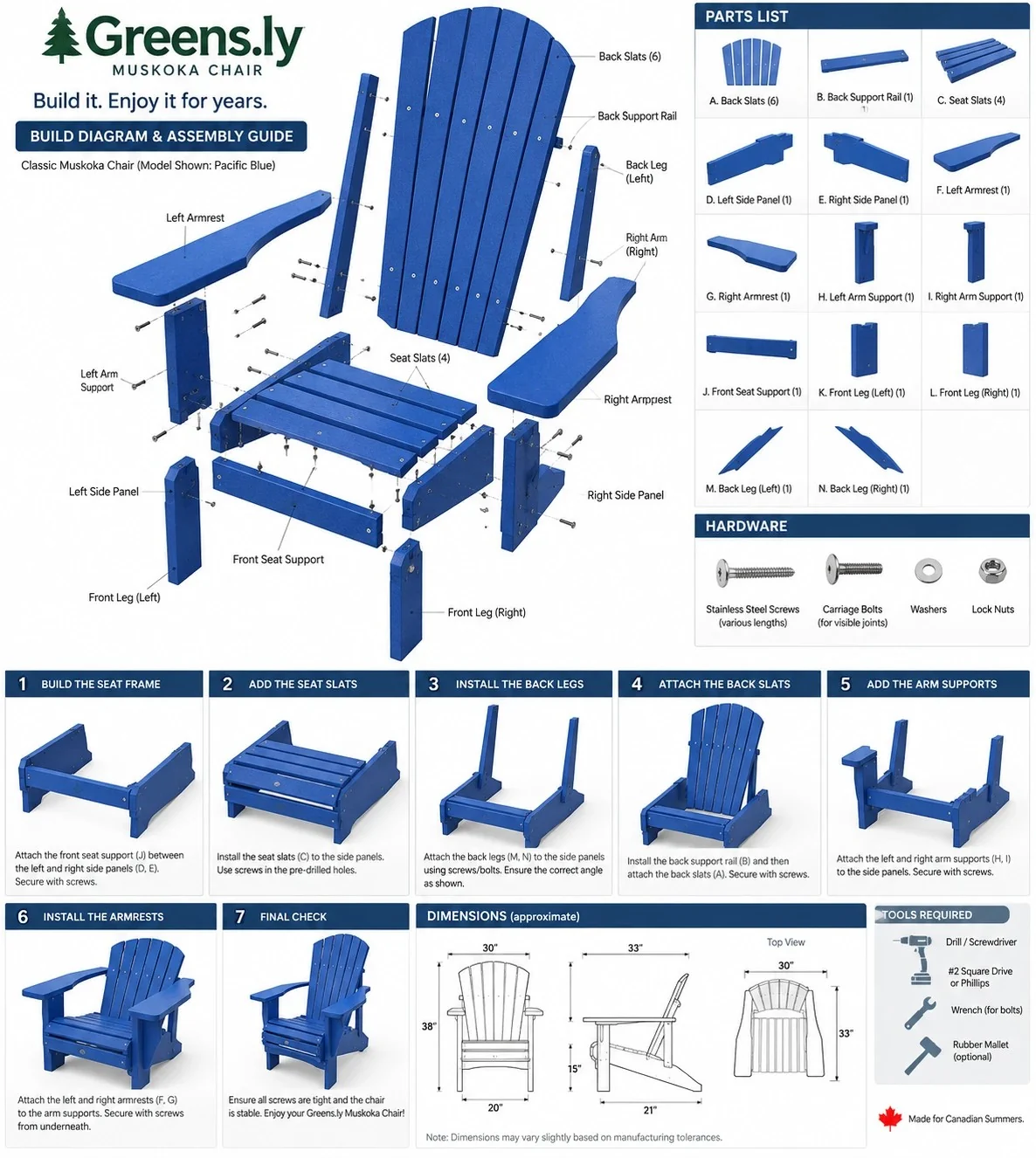
The boards, the hardware and the instructions go into one flat carton. Assembly takes about twenty minutes with a screwdriver or a drill. The chair ships from Ontario and is built to your order, in your colour, in about 3–6 weeks.
Questions
Is it really 100% recycled?
The HDPE is 100% post-consumer. Pigment and UV stabiliser are added to the melt, as they must be for any outdoor-grade board; they are a few percent by weight.