
Why the seat tilts and the arms are wide
Every line has a job. Most of them are about taking weight off you.
The tilt
The seat is higher at the front than the back — on ours, 15 inches at the front edge, dropping toward the rear. That tilt does two things. It sits the chair level on a slope, which is what it was designed for. And on flat ground it rolls your weight back onto your pelvis and off your thighs, which is why you can sit in one for three hours and a dining chair for one.
The back
The back leans at roughly the angle of a person leaning back in a good mood. It is tall — 39 inches on ours — so it supports the shoulders and the head, and it is slatted so it drains, flexes slightly, and does not press one flat board into your spine.
The arms
Five and a half inches wide, dead flat, at 22 and a half inches from the ground: the height of a table beside a low chair. They hold a drink, a plate, a book, a phone, an elbow. They are also structural — they tie the back to the front legs — which is why a Muskoka chair does not need stretchers between the legs and looks so open from the front.
The low front
The front edge of the seat is low and rounded so it does not cut into the back of your knees when your legs are out straight, which in this chair they always are. It is also why the ottoman exists: with your feet on it, the recline is complete and there is no pressure anywhere.
The famous problem
All of this is why it is a little hard to get out of. Push down on the arms; that is what they are for. The technique, honestly explained.
The numbers, for ours
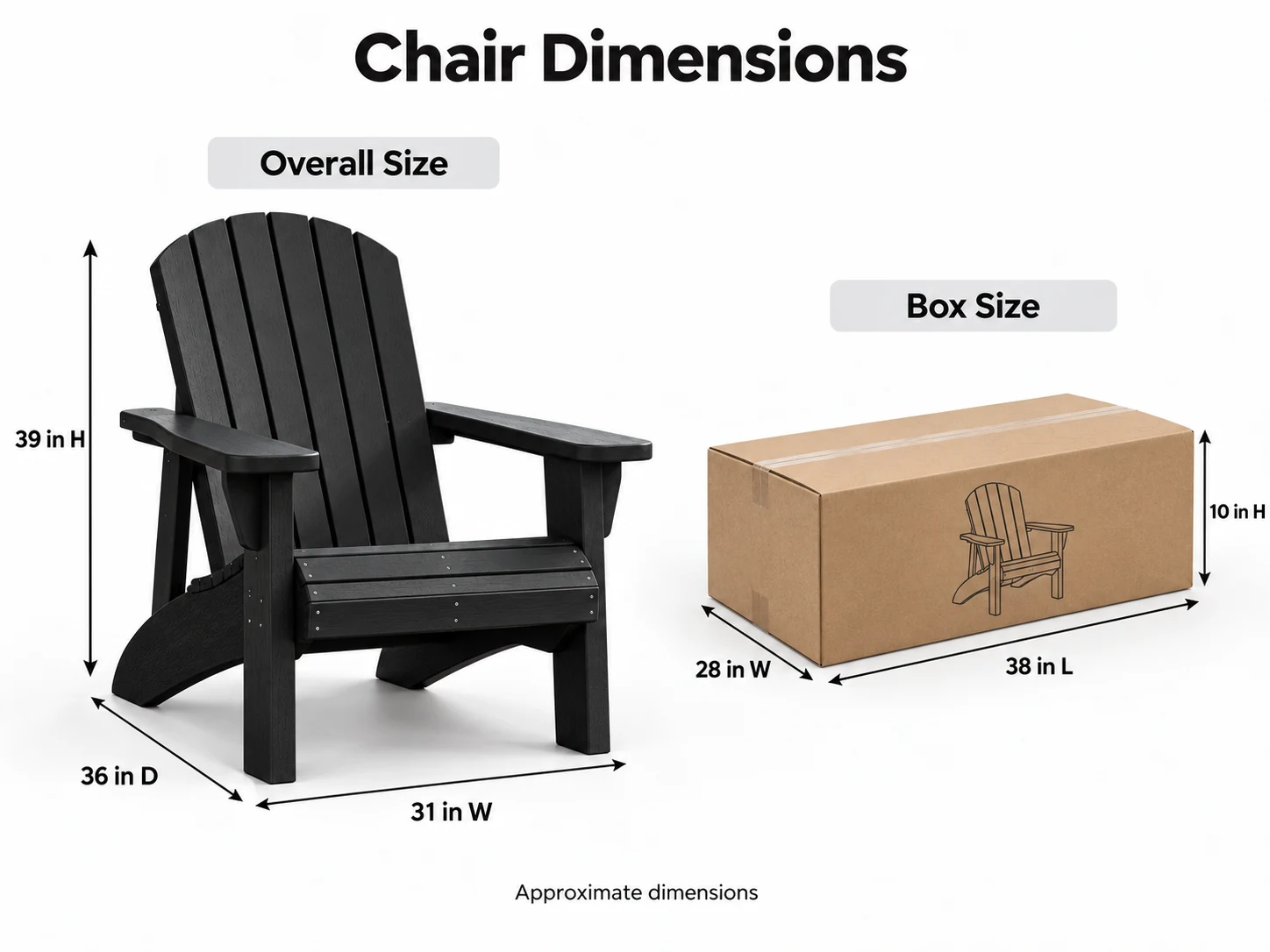
- Assembled: 31" wide, 36" deep, 39" tall
- Seat: 20" wide, 21" deep, 15" at the front
- Arms: 5½" wide, 22½" high
- Boards: 1" thick, 5 back slats, 4 seat slats
- Weight: about 38 lb