
The Adirondack chair, explained
One shape, a hundred and twenty years old, built for sitting outside doing nothing in particular. Here is where it comes from, why it works, what it is made of now, and how to buy one that will still be there in twenty summers.
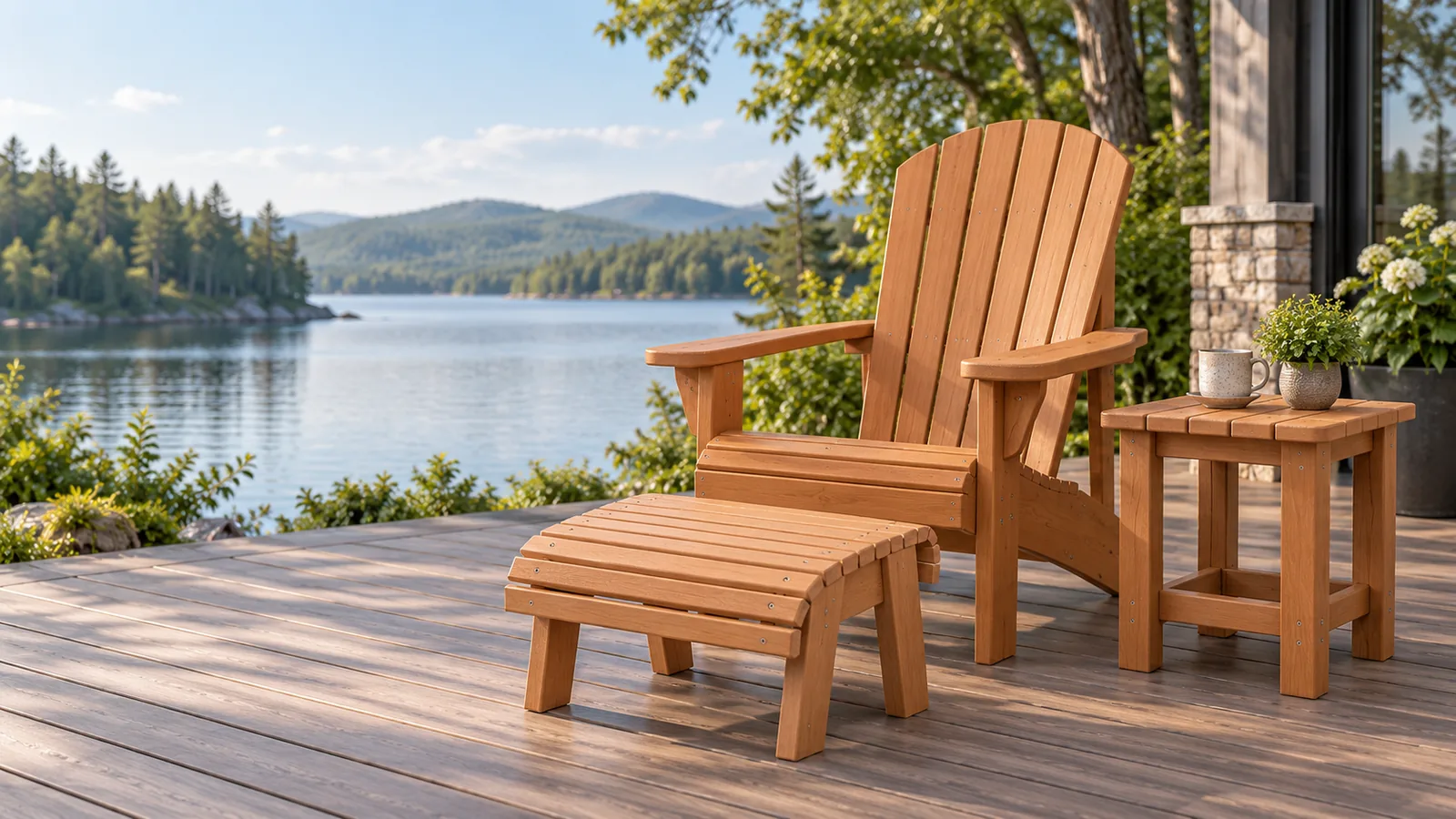
What an Adirondack chair is
A low, wide outdoor chair with a tilted-back seat, a tall slatted back and arms broad enough to hold a drink. The seat is close to the ground at the front and lower still at the back, so you sit in it rather than on it, with your weight settled and your feet out in front. It was designed for a slope, which is why it feels so good on flat ground: the recline is built into the frame, not into a mechanism.
In Canada it is a Muskoka chair, after the lake district north of Toronto where cottagers adopted it. In the United States it is an Adirondack chair, after the mountains in upstate New York where it was invented in 1903. Same chair, two names — the story is worth five minutes.
Why it is shaped like that
Thomas Lee built the first one in Westport, New York, for his family's summer place on a hillside. He wanted a chair that would sit level on uneven ground and let a person lean back without a cushion, so he tilted the seat, angled the back, and made the arms wide enough to set a plate on. Eleven boards, one plank each, cut with a hand saw. The slatted back came later, in the 1930s, and the fan-shaped back after that; the geometry never changed because it never needed to.
The result is a chair that is comfortable for hours — the recline takes the weight off the lower back, the arms take the weight off the shoulders — and one that is famously a little hard to get out of. That is what the ottoman is for. The geometry, drawn out.
What it is made of now
For a hundred years it was wood: cedar, pine, teak, whatever was local. Wood is beautiful for a season. Then it greys, the paint or stain fails, water gets into the end grain, and the chair starts a long argument with the weather that it always loses. Every spring: sand, stain, repeat. Here is what three summers do.
The chair we make is 100% recycled HDPE — the plastic milk jugs are made from — cleaned, ground, colored all the way through and pressed into solid lumber that is milled and bolted exactly like the wooden original. About five hundred jugs go into each chair. It does not absorb water, so nothing rots or freezes inside it. The color is in the material, not on it, so there is nothing to peel, chip or fade unevenly. It is heavier than wood on purpose. It sits outside all year and is hosed off in spring. How that happens.
How to choose one
- Material first. Wood if you want the grain and will do the upkeep. Recycled HDPE poly lumber if you want to buy it once. Avoid thin moulded resin: it is light, it blows over, and it cracks in a cold winter. Resin vs poly lumber.
- Weight is a feature. A real poly-lumber chair weighs around 35–40 lb. If the one you are looking at is half that, it is hollow.
- Hardware. Stainless steel or nothing. Zinc-plated screws streak rust down the slats within two summers.
- Color through the board. Ask whether the color is pigmented through or coated. Coated chairs show white at every scratch.
- Warranty and returns. Twenty years on the material is normal for the good ones. Thirty days to return it after it arrives is fair. Anything less, ask why.
- Sets. Most people end up with two, then four. Buy them together and every chair should cost less. The layouts, and the discount.
The long version: how to choose an Adirondack chair.
Ours
We make one chair, in fourteen colors, at our own factory in Texas, and deliver it free anywhere in the lower 48 states. $229 USD, down from $449. A matching ottoman ($79) and side table ($59) in the same color. Sets of two, four and six are 15, 20 and 25 percent off every chair. Twenty-year warranty, thirty-day returns with shipping paid, and you can cancel free any time before it goes into production.
The colors
Compared
- Adirondack chair: wood vs recycled HDPE
- Adirondack chair: cheap plastic vs poly lumber
- Adirondack chair: teak vs recycled HDPE
- Adirondack chair: metal vs recycled HDPE
- Greens.ly vs Polywood
- The Costco Adirondack chair vs ours
- The Amazon Adirondack chair vs ours
- Muskoka chair vs Adirondack chair
- Adirondack chair: folding vs fixed
- Adirondack chair vs Adirondack rocker
Guides
- How to choose an Adirondack chair
- How big is an Adirondack chair?
- How many Adirondack chairs fit?
- How to clean and care for an Adirondack chair
- Can you leave an Adirondack chair outside all winter?
- Assembling an Adirondack chair
- How heavy is an Adirondack chair, and why that's the point
- How much weight can an Adirondack chair hold?
- What is HDPE poly lumber, exactly?
- Adirondack chairs round a fire pit
- Adirondack chairs by the pool
- Do you need a cushion on an Adirondack chair?
- Choosing a color for your deck, dock or patio
- Why the ottoman's angle matters
- Adirondack chairs for resorts, restaurants and rentals
- What an Adirondack chair really costs over ten years
- How the Adirondack chair ships
- What the 20-year warranty actually covers
- An Adirondack chair as a gift
- Sets of 2, 4 and 6: the layouts and the discount
Stories
- Where the Adirondack chair comes from
- Why the seat tilts and the arms are wide
- From milk jug to chair
- Why paint fails on wood outdoors, and pigment doesn't
- A hundred years of the same chair
- The patio, the deck and the dock
- What "made in Texas" actually means
- How to sit in an Adirondack chair, and how to get out of one
- Why we only make one chair
- The colors, and where their names come from
Where it goes
- Adirondack chairs for the cottage
- Adirondack chairs for the deck
- Adirondack chairs for the dock
- Adirondack chairs for the fire pit
- Adirondack chairs for the pool
- Adirondack chairs for the patio
- Adirondack chairs for a balcony
- Adirondack chairs for the porch
- Adirondack chairs for the garden
- Adirondack chairs for the beach house
- Adirondack chairs for a restaurant or brewery patio
- Adirondack chairs for resorts and campgrounds
Lists
- 7 things nobody tells you before you buy an Adirondack chair
- 14 colors, 14 backyards: which Adirondack chair color for which deck
- 9 reasons the chair on your dock is grey
- 5 ways to arrange 4 Adirondack chairs round a fire pit
- The 10-year cost of a cheap chair vs a $229 chair
- 8 questions to ask any outdoor furniture company before you pay
- 6 lakes that gave outdoor furniture its names
- The 11 boards: how a 1903 chair was designed with a hand saw
- 10 cottage-warming gifts that will still be there in twenty years
- The 5 most common Adirondack chair complaints, and which are our fault
Where we deliver in the United States
- The Adirondacks
- New York
- Vermont
- Maine
- New Hampshire
- Massachusetts
- Connecticut
- New Jersey
- Pennsylvania
- Michigan
- Wisconsin
- Minnesota
- Texas
- Colorado
- North Carolina
- South Carolina
- Georgia
- Florida
- Tennessee
- Ohio
- Illinois
- Washington
- Oregon
- California
- Lake Tahoe
- Arizona
- The Finger Lakes
- Lake of the Ozarks
- The Outer Banks
Glossary
- HDPE
- Poly lumber
- Recycled plastic lumber
- Resin (moulded plastic)
- Composite (wood-plastic)
- UV stabiliser
- Colorfast
- Pigmented through
- Marine grade
- Stainless steel hardware
- Adirondack chair
- Muskoka chair
- Westport chair
- Slat back
- Fan back
- Contoured seat
- Ottoman
- Footstool
- Side table
- Deck chair
- Patio chair
- Lounge chair
- Outdoor furniture
- Made to order
- Lead time
- Curbside delivery
- Flat-pack
- Residential warranty
- Commercial warranty
- Fire pit chair
- Dock chair
- Cottage furniture
- Set pricing
Questions
Is an Adirondack chair the same as a Muskoka chair?
Yes. Same chair, same shape, same history. Canadians named it after the Muskoka lakes; Americans after the Adirondack mountains where it was designed in 1903.
What is the best material for an Adirondack chair?
Recycled HDPE poly lumber, if you want to buy it once. It does not rot, absorb water, peel or need staining, and it weighs enough to stay put in wind. Wood looks lovely for a season and then needs yearly upkeep.
How much does a good Adirondack chair cost?
A solid poly-lumber chair from a real maker is usually $449–$500. Ours is $229 USD with free delivery, and less per chair in sets of two, four or six.
Can it stay outside all winter?
Yes. HDPE does not absorb water, so there is nothing for frost to crack. Leave it out, brush the snow off it in April, hose it down.
How long does delivery take?
Each chair is built to order in Texas, so about 3–6 weeks from your order to your door, delivered free.